
Most magicians think the opening of a magic show begins with the first trick.
It begins before that.
Before you produce a card, tie a knot, borrow an object or invite someone to help, your audience is already deciding how they feel about you—and about what is about to happen.
Are they comfortable? Are they guarded? Do they trust you? Do they want to participate? Are they merely watching… or are they beginning to lean in?
That’s why choosing the perfect opener isn’t simply about finding a strong trick.
Your first job is to change the audience.
In this complete guide, we’re going to explore what really happens during those critical opening minutes, the seven things a great opener must accomplish, how to choose an opening routine that fits your show, and how to know when it is truly show-ready.
Because the secret to a great opening is surprisingly simple:
Before you open the show… open the audience.
HOW TO USE THIS GUIDE
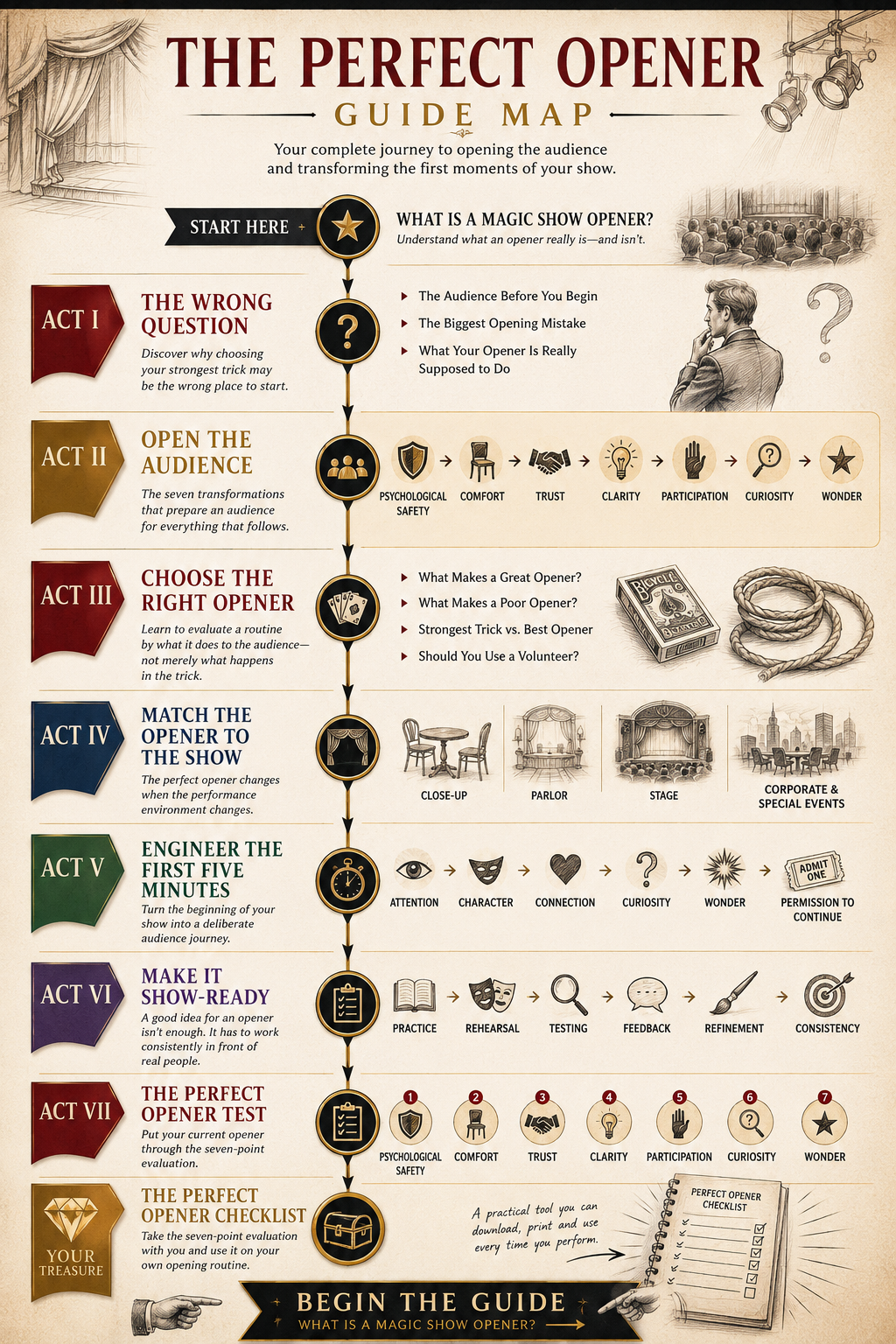
You can read The Perfect Opener from beginning to end, or use the Guide Map above to jump directly to the question you’re trying to solve.
But if you’re building or rebuilding the opening of your show, I recommend beginning at the start.
There’s a reason.
Choosing the trick comes later. First, we need to understand the audience we’re choosing it for.
YOUR PERFECT OPENER CHECKLIST
As you move through this guide, you’ll discover the seven things I look for in an opening routine. At the end, you’ll be able to put your own opener through the same evaluation.
Don’t worry about your score yet. By the time we get there, you’ll understand exactly what each question means.
FROM ATTILLIO
I’ve spent decades performing magic, teaching magicians and studying what happens between a performer and an audience. The ideas in this guide didn’t begin as theories. They grew from performances, rehearsals, students, successes, mistakes and thousands of moments spent watching audiences respond.
WHAT IS A MAGIC SHOW OPENER?
Ask most magicians what an opener is and you’ll probably hear some version of:
“It’s the first trick in the show.”
Technically, that’s true.
But it’s almost useless.
Because if all we know about an opener is that it comes first, we’ve learned nothing about what that opening routine actually needs to accomplish.
And that’s where many magicians get into trouble.
They begin looking through the magic they already own.
Cards. Coins. Rope. Mentalism. A visual production. Something funny. Something fast.
Then they ask:
“Which one of these would make a great opener?”
That’s a reasonable question.
It’s just not the first question.
Before we decide what the magician should do, we need to understand something far more important:
What is happening to the audience before the magician does anything at all?
WHAT IS YOUR OPENER REALLY SUPPOSED TO DO?
Now we can return to our original question.
What is a magic show opener?
Yes, technically, it’s the first routine in your show.
But that’s its position.
It isn’t its purpose.
I want you to begin thinking about an opener differently:
Your opener is the first deliberate transformation of your audience.
Think about the people sitting in front of you before you begin.
They may be:
Uncertain.
Guarded.
Unfamiliar with you.
Unsure about participating.
Waiting to decide whether they like this.
And now think about where you’d like them to be a few minutes later.
Comfortable.
Trusting.
Engaged.
Curious.
Willing to participate.
Ready to experience wonder.
Look at the difference between those two audiences.
That’s the real work of your opener.
You’re not simply trying to get from:
TRICK ONE → TRICK TWO
You’re trying to move from:
THE AUDIENCE YOU INHERITED
to
THE AUDIENCE YOUR SHOW NEEDS.
And suddenly choosing an opening trick becomes a very different problem.
We’re no longer asking:
“Which trick should I do first?”
We’re asking:
“What does my audience need from me first?”
That question changes everything.
BEFORE YOU OPEN THE SHOW…
This is the central principle behind everything we’re going to explore in this guide.
Your opener certainly needs good magic.
Technique matters.
Entertainment matters.
Character matters.
A strong effect matters.
But none of those things exist in isolation.
They’re being experienced by human beings who are forming an opinion of you, learning how your show works and deciding—moment by moment—how much of themselves they’re willing to give you.
Attention.
Trust.
Participation.
Curiosity.
Emotional investment.
Your opening minutes begin establishing all of them.
That’s why I don’t think of the perfect opener simply as the trick that begins the show.
I think of it as the routine that begins changing the audience.
Before you open the show… open the audience.
And once we understand that, another question becomes unavoidable:
What exactly needs to change?
That’s where our seven elements begin.
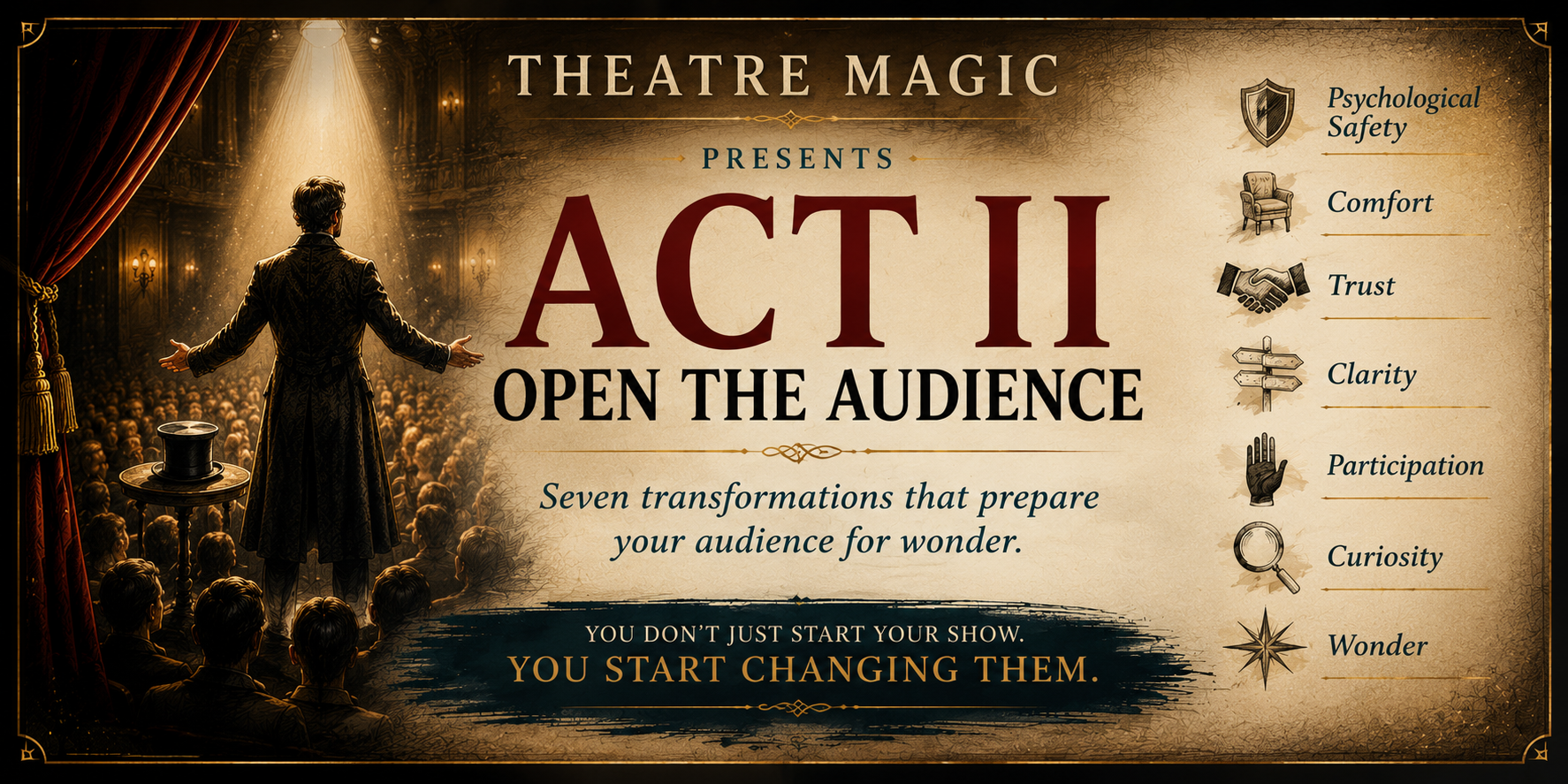
NEXT: ACT II — OPEN THE AUDIENCE
A great opener begins moving the audience through seven essential conditions:
Psychological Safety → Comfort → Trust → Clarity → Participation → Curiosity → Wonder
Next, we’ll look at each one—and why the order matters.
THE BIGGEST OPENING MISTAKE
Once you understand the audience you’re inheriting, the question many magicians ask begins to look very different:
“What’s my strongest trick?”
It’s an understandable question.
You want to start strong. You want something impressive. Something visual. Something reliable. Something you know can produce a big reaction.
But there’s an important distinction:
Your strongest trick and your best opening trick are not necessarily the same thing.
A routine can be extraordinary magic—and still be wrong for the first few minutes of your show.
Consider a routine that requires immediate audience participation.
The magic may be phenomenal.
But what if the audience doesn’t trust you yet?
Or imagine opening with a complicated premise requiring the audience to remember several things before the magic can even happen.
The ending might be astonishing.
But your audience is still learning who you are, what matters and where their attention belongs.
Or perhaps you begin with aggressive comedy at the expense of a volunteer.
It gets a laugh.
But what has everyone else in the room just learned?
Maybe:
“Don’t let this magician choose me.”
The joke worked.
The trick worked.
The audience laughed.
And the opening may still have failed.
That’s why applause alone isn’t enough to evaluate an opener.
We need to ask:
Did the audience become more comfortable?
Did uncertainty decrease?
Did trust increase?
Did they understand me better?
Did they become more curious?
Are they more willing to participate now than they were three minutes ago?
And perhaps most importantly:
Do they want to see what happens next?
That leads us to a very different standard for judging an opening routine.
💎 Don’t judge your opener only by the reaction it gets. Judge it by the audience it creates.
THE OPENER’S REAL JOB
Now we can return to the question we started with:
What is a magic show opener?
Yes, it’s the first routine in your show.
But that’s its position.
It isn’t its purpose.
The real job of your opener is to begin moving the audience from the psychological state in which you inherited them toward the state your show needs.
From:
Uncertain → Comfortable
Guarded → Trusting
Evaluating → Engaged
Hesitant → Willing
Watching → Curious
And eventually:
Ready for Wonder.
This is why I think of an opener as something much more important than Trick Number One.
Your opener is the first deliberate transformation of your audience.
You’re not simply moving from:
TRICK ONE → TRICK TWO
You’re moving from:
THE AUDIENCE YOU INHERITED → THE AUDIENCE YOUR SHOW NEEDS
And once you begin thinking this way, the question changes.
Instead of asking:
“What trick should I perform first?”
you begin asking:
“What does my audience need from me first?”
That’s the better question.
And answering it brings us to the heart of The Perfect Opener.
Because if our job is to open the audience, we need to understand exactly what we’re trying to open.
There are seven essential conditions I want you to begin looking for:
Psychological Safety.
Comfort.
Trust.
Clarity.
Participation.
Curiosity.
Wonder.
They don’t simply describe a good audience.
Together, they describe a journey.
And that journey begins with something most magicians rarely think about when choosing their opening trick.
Psychological safety.
ACT I — THE WRONG QUESTION
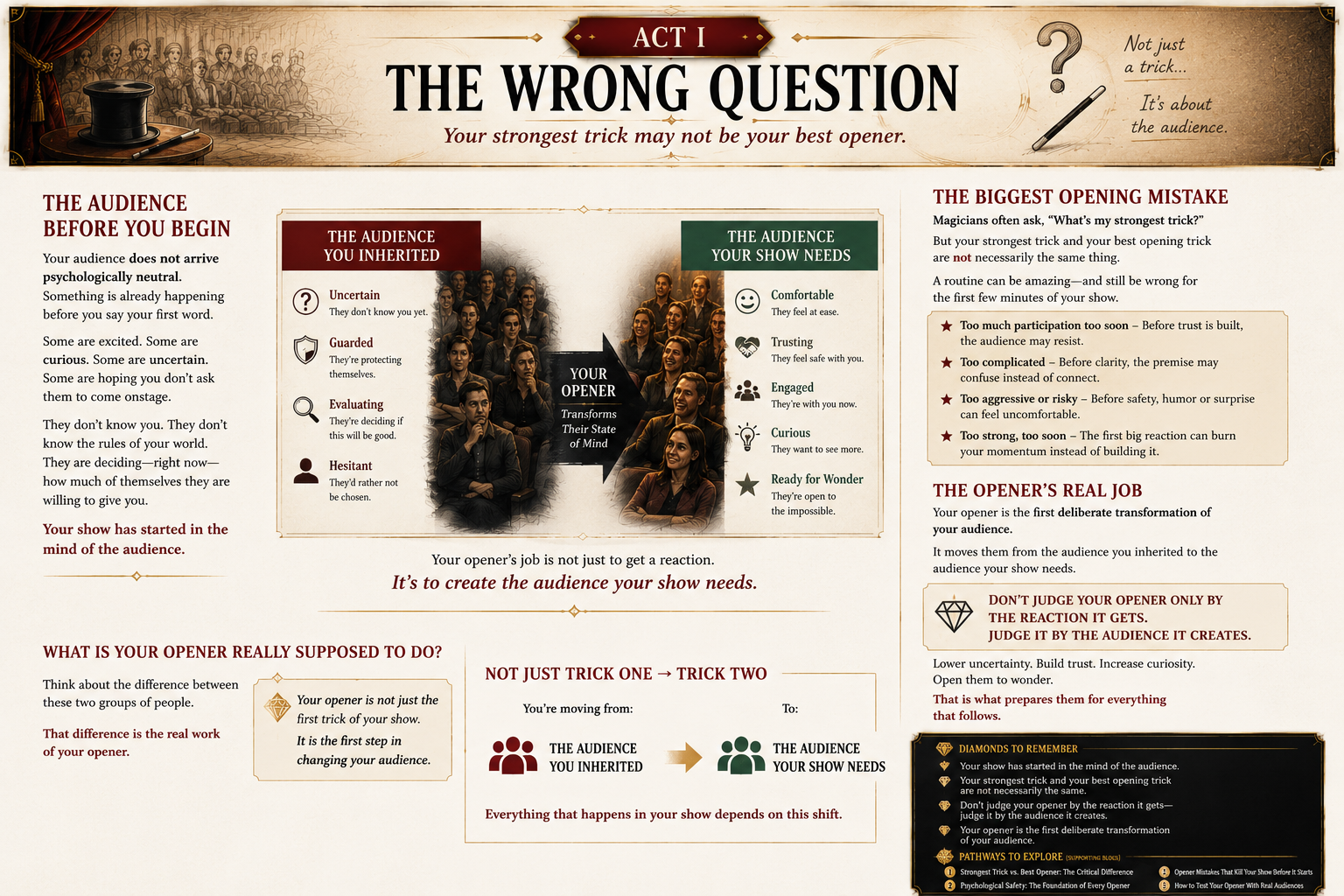
THE AUDIENCE BEFORE YOU BEGIN
Your audience does not arrive psychologically neutral.
Something is already happening before you say your first word.
Some people are excited.
Some are curious.
Some may already love magic.
Others have seen magic they didn’t enjoy.
Some are wondering whether they’re going to be embarrassed.
Some are hoping you don’t ask them to come onstage.
Some may be sitting farther back precisely because they don’t want to become part of the show.
Others are simply trying to figure you out.
Who is this person?
Is this going to be good?
Am I going to enjoy this?
Is he going to pick on somebody?
Is he going to pick me?
And there may be another question underneath all of those:
Can I relax?
This matters enormously.
Because while you’re thinking about your first trick, your audience may be dealing with something completely different.
Uncertainty.
They don’t yet know the rules of your world.
They don’t know how you treat people.
They don’t know what participation means in your show.
They don’t know whether you’re going to challenge them, embarrass them, fool them, tease them, amaze them—or some combination of all five.
They haven’t learned how to experience you yet.
That means something important has already happened before your opening trick begins.
Your show has started in the mind of the audience.
💎 The audience arrives before the show begins—but psychologically, your show has already begun.
Imagine beginning with a complicated premise.
The ending may be astonishing.
But what if your audience is still trying to understand who you are and what kind of experience they’re entering?
Imagine opening with aggressive comedy at the expense of a volunteer.
It might produce laughter.
But what has the rest of the audience just learned?
Perhaps:
Don’t let this magician choose me.
The trick succeeded.
The opening may have failed.
That’s the distinction I want you to begin noticing.
We’re not evaluating an opener only by asking:
Did the trick work?
Did they laugh?
Did they applaud?
Were they fooled?
We’re asking something bigger:
What did this routine do to the audience?
Did they become more comfortable?
Did they begin trusting you?
Did uncertainty decrease?
Did curiosity increase?
Did they understand your character?
Did they learn how participation works in your show?
Did they begin wanting more?
Because the purpose of your opener isn’t merely to produce the first reaction.
It’s to prepare the audience for everything that comes afterward.
💎 Don’t judge your opener only by the reaction it gets. Judge it by the audience it creates.