
The History of Coin Magic: From the Coin Behind the Ear to the Midas Coin and Coin Fountain
From a single coin appearing behind a child’s ear to a seemingly endless fountain of money, discover how one of magic’s simplest mysteries became a timeless art—and how Attillio brought his own approach to this classic of conjuring.
The Coin Behind the Ear
One small coin. One impossible moment. A childhood memory that can last a lifetime.

Long before you knew what sleight of hand was, before you ever heard the words misdirection or coin manipulation, there’s a good chance you experienced one of the oldest and most recognizable moments in magic.
Someone looked at you with a curious expression.
They leaned a little closer, studying the side of your head as though they had just discovered something extraordinary.
“Wait a minute. What’s that behind your ear?”
A hand reached toward you, fingers disappeared behind your ear, and an instant later…
There was a coin!
Where did it come from?
How did it get there?
And perhaps the most important question of all…
Could they do it again?
For a child, that tiny moment can open the door to an entirely new world. Suddenly, ordinary objects aren’t quite so ordinary. The impossible has become possible, and the person standing in front of you apparently possesses a remarkable ability.
They can make money appear out of thin air!
But something much more interesting has taken place.
The Magic Didn’t Just Happen in Front of You. It Happened to You.
Think about that for a moment.
The magician could have produced a coin from an empty hand. That alone would have been surprising.
Instead, the magician reached behind your ear.
You weren’t simply watching the magic. You became part of it.
And that simple distinction reveals an important principle of theatrical magic.
THEATRE MAGIC · THE PRINCIPLE
“The strongest magic doesn’t always happen in front of the audience. Sometimes it happens to the audience.”
— Attillio

When a magician finds money behind someone’s ear, the spectator becomes the source of the impossible.
There is no complicated story to follow. No elaborate apparatus. No stage, theatrical lighting or expensive equipment.
Just a familiar object, a simple action and an extraordinary result.
Yesterday, the space behind your ear was just the space behind your ear.
Today, it might contain money.
And who’s to say there isn’t another coin hiding behind your other ear?
Or in your pocket?
Or somewhere else entirely?
The possibilities suddenly seem endless.
A Tiny Miracle With an Extraordinary Advantage
One of the wonderful things about coin magic is that it requires almost no introduction.
Everyone recognizes a coin. We understand its purpose, its value, its weight and the familiar sound it makes when it lands on a hard surface.
That’s what makes its sudden appearance so effective.
There is nothing unusual about the object itself.
The unusual thing is what just happened to it.
The audience doesn’t need to learn the rules of a game or understand the properties of some mysterious magical apparatus.
They know what they saw.
A coin appeared where there wasn’t one before.
And in that instant, a magician has accomplished something rather remarkable.
An everyday object has become a source of wonder.
But magicians are curious people. Producing one coin raises another intriguing possibility.
What if you could produce a second?
And a third?
What if coins could be discovered in the most unexpected places, one after another, until it seemed that the magician possessed the extraordinary ability to create money whenever and wherever it was needed?
That simple idea would eventually help inspire some of the most entertaining and celebrated routines in the history of coin magic.
But before we explore how one coin became a seemingly endless fountain of money, there’s another fascinating question worth asking.
Why did magicians fall in love with coins in the first place?
Why Coins Were Destined for Magic
Small enough to disappear. Familiar enough to require no explanation. Valuable enough to capture our attention. Discover why an ordinary coin became one of the magician’s most extraordinary instruments.
There are certain objects that seem almost designed for magic.
A deck of cards can be shuffled, cut, selected and transformed.
A length of rope can be tied, cut and restored.
A silk handkerchief can vanish in an instant.
But a coin possesses something different.
A coin already belongs to the audience’s world.
You don’t have to explain what it is.
You don’t have to convince anyone that it is ordinary.
You don’t have to ask the spectator to imagine why it matters.
They already know.
A coin is familiar.
A coin has weight.
A coin has value.
And perhaps most importantly—
a coin is small enough to disappear.
That combination made it almost inevitable that magicians would begin experimenting with what could happen when something so ordinary was placed into an extraordinary situation.
The Perfect Size for an Impossible Idea
Hold a coin between your fingertips.
It is large enough for an audience to see.
Small enough for the hand to conceal.
Solid enough to make a sound.
Reflective enough to catch the light.
And familiar enough that nobody suspects the object itself.
Those qualities give the magician an extraordinary range of possibilities.
A coin can appear.
Disappear.
Travel.
Multiply.
Change.
Pass through something solid.
Move from one hand to another without apparently traveling between them.
Or appear in a place where it could not possibly be.
And because the object is so familiar, the audience immediately understands the impossibility.
There is very little explanation required.
The magician can simply show the coin—
and begin.
That is an enormous theatrical advantage.

Familiar Objects Create Immediate Clarity
One of the greatest challenges in magic is getting the audience to understand what is supposed to be impossible.
If the object is unfamiliar, part of the audience’s attention may be spent trying to understand the object.
What is that?
How does it work?
Is it some special magician’s device?
A coin eliminates much of that uncertainty.
The audience has probably held one.
Spent one.
Dropped one.
Flipped one.
Heard one strike a tabletop.
They already know how a coin behaves in the real world.
And that gives the magician something incredibly valuable:
A set of rules the audience already understands.
Coins do not disappear when you close your hand.
Coins do not multiply because you wave your fingers over them.
Coins do not travel invisibly through space.
Coins do not fall upward.
So when one of those things appears to happen, the audience immediately recognizes that something impossible has taken place.
The Sound of Money
Coin magic is not only visual.
It has sound.
A coin dropped onto a table announces itself.
A handful of coins creates a completely different sensation.
The metallic clink of one coin striking another can become part of the magic before the spectator even understands what has happened.
That sound gives coin magic a quality many other close-up objects do not possess.
The audience can hear the magic accumulating.
One coin.
Then another.
Then another.
The sound itself begins to suggest abundance.
And later, when magicians began producing coins one after another into a hat, bucket or container, that sound became part of the theatrical experience.
The audience wasn’t simply seeing money appear.
They were hearing it.

There Is Something About Making Money Appear
Then there is another advantage.
Coins represent value.
That matters.
Imagine reaching into the air and producing a small piece of blank cardboard.
Technically, that could still be magical.
But produce a coin—
and something changes.
Because a coin represents possibility.
It buys something.
It belongs in a pocket.
It can be saved.
Spent.
Given away.
Collected.
And because money has played such an important role in everyday life for centuries, making it appear from nowhere carries an instinctive appeal.
It feels useful.
Desirable.
Almost mischievous.
A magician who can produce money seemingly whenever he wishes appears to possess an ability almost everyone has imagined at one time or another.
What if I could simply make money appear?
That fantasy is built directly into coin magic.
A Magician Could Carry an Entire Act in a Pocket
Another reason coins became so important to magicians is wonderfully practical.
You don’t need a trunk.
You don’t need a stage.
You don’t need an assistant.
You don’t need an elaborate piece of apparatus.
A few coins can disappear into a trouser pocket and travel anywhere with you.
That makes coin magic naturally suited to one of the most powerful situations a magician can encounter:
Someone suddenly says—
“Show me something.”
A magician with a few coins—or sometimes simply access to the money already in the room—can create an experience almost anywhere.
At a table.
At a party.
In a restaurant.
Standing in a hallway.
Sitting in someone’s living room.
That portability helped make coin magic one of the natural languages of close-up and impromptu magic.
THEATRE MAGIC · THE PRINCIPLE
The less explanation an object requires, the faster the audience can enter the magic.
— Attillio
That is one of the great advantages of a coin.
The audience doesn’t have to understand the prop.
They already do.
Which means the magician can spend less time explaining—
and more time creating the experience.
Ordinary Object. Extraordinary Possibilities.
This is one of the things I find most interesting about coin magic.
The coin itself is almost never the most important part.
It is what the magician causes the audience to believe is happening to it.
An ordinary object becomes impossible because of context.
Put a coin on a table and nobody pays much attention.
Make that same coin disappear from your fingertips—
and suddenly every eye is watching.
Produce it from behind someone’s ear—
and an ordinary coin becomes a childhood memory.
Cause another coin to appear—
and now the audience begins to wonder if the first one was merely the beginning.
And once that thought enters the room, an entirely new possibility opens.
Because if a magician can produce one coin…
Why stop at one?
THEATRE MAGIC DIAMOND
Familiarity makes impossibility clearer.
The more completely the audience understands how an ordinary object is supposed to behave, the more powerful it can become when the magician apparently breaks those rules.
That principle goes far beyond coin magic.
It applies to cards.
Rope.
Rings.
Keys.
Pens.
Phones.
Almost anything the audience encounters in everyday life.
Sometimes the most powerful magical prop is the object that never looked like a magic prop in the first place.
One coin appearing from nowhere is a miracle.
But the history of coin magic did not stop there.
Magicians began asking a wonderfully dangerous question:
If I can produce one coin… how many can I produce before the audience stops believing their own eyes?
That question takes us directly into one of the most enduring plots in all of coin magic.
From One Coin to Many: The Birth of the Miser’s Dream
One coin is impossible. A seemingly endless stream of them becomes theatre.
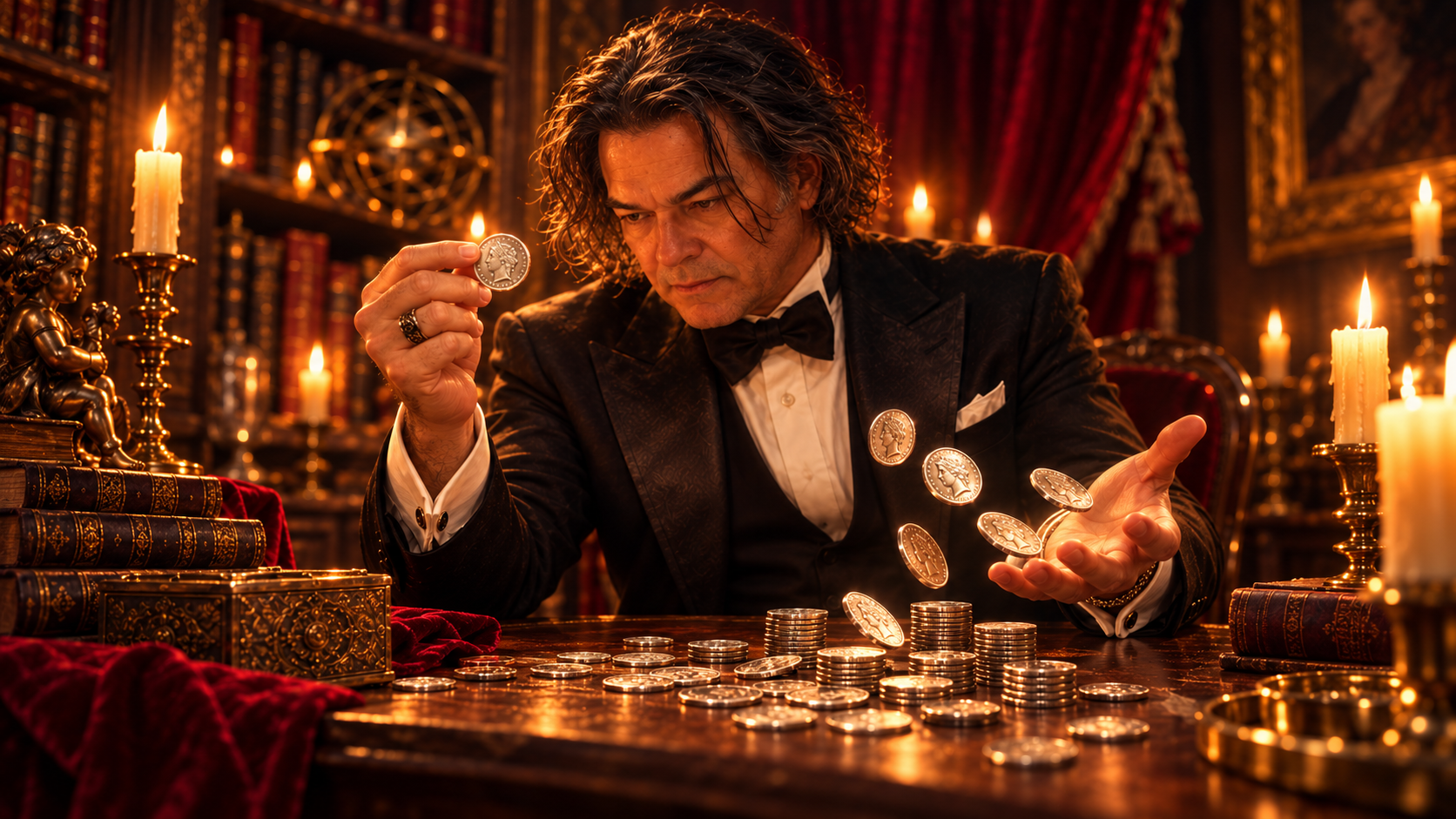
A magician reaches into empty space and finds a coin.
That is surprising.
He reaches again—
and finds another.
Then another.
And another.
Very quickly, something changes.
The audience is no longer watching a single impossible event.
They are watching an impossible ability.
The magician has apparently discovered something the rest of us cannot see: money is everywhere.
Floating in the air.
Hiding behind someone’s ear.
Waiting beneath a sleeve.
Perhaps hanging invisibly just above our heads.
All the magician has to do is reach out—
and take it.
That wonderfully simple premise became one of the most enduring plots in coin magic:
The Miser’s Dream
When Small Magic Became Big Enough for the Stage
A coin is tiny.
That creates an obvious problem.
How do you take something that can disappear beneath two fingers and make it interesting to hundreds of people sitting inside a theater?
You make the effect larger than the object.
The audience doesn’t need to examine every detail engraved on the coin.
They need to understand what is happening.
The magician reaches into empty space.
A coin appears.
He throws it into a container.
Another appears.
Then another.
The rhythm grows.
The locations change.
The amount of money increases.
What began as a tiny object develops into a large theatrical idea.
This is a distinction I want magicians to understand.
Stage magic doesn’t always require a large prop.
It requires a large enough experience.
A silver coin may only be an inch or so across.
But the idea—
this man can apparently create money from nothing—
can fill an entire theater.
The Audience Could See the Character Through the Trick
This is another reason specialization matters.
Perform the same kind of material long enough and it begins revealing who you are.
Are you playful?
Sophisticated?
Mischievous?
Elegant?
Comedic?
Mysterious?
The trick becomes a vehicle for character.
Imagine two magicians performing essentially the same effect.
Both produce twenty coins.
The first magician silently demonstrates astonishing dexterity.
The second finds the coins on spectators, reacts to discoveries, varies the rhythm, builds suspense, creates laughter and gradually leads the audience toward a climax.
Technically, both may have performed coin productions.
Experientially—
they performed completely different shows.
Method tells us how the coin appeared.
Character tells us why we cared.
That difference sits at the center of Theatre Magic.
THEATRE MAGIC · THE PRINCIPLE
Technique earns the possibility. Presentation earns the memory.
— Attillio
A difficult palm can make a coin disappear.
A beautifully structured moment can make an audience remember that disappearance twenty years later.
Those are not the same accomplishment.
The strongest performers learn to pursue both.
The Book That Helped Preserve the Work
Downs also did something particularly important for generations of magicians who came after him.
He documented the work.
His Modern Coin Manipulation became a major written record of coin technique and presentation. Its contents include the Miser’s Dream, coin productions, vanishes, passes, palming techniques, multiplying coins and numerous other approaches to manipulating money.
Decades later, J. B. Bobo’s enormously influential Modern Coin Magic would continue that tradition. The expanded Bobo volume specifically preserves a section on the Miser’s Dream that includes Downs’ original version and a number of techniques associated with him.
That means a performance that once existed for a live audience could continue influencing magicians who were not even born when Downs was working.
That is the extraordinary power of documenting an artistic idea.
You perform it.
You refine it.
You teach it.
Someone else studies it.
They adapt it.
And eventually the idea moves forward again.
When One Miracle Becomes a Pattern
There is an important theatrical difference between producing one coin and producing many coins.
The first coin creates surprise.
The second tells the audience the first was not an accident.
The third establishes a pattern.
And once the audience understands the pattern, anticipation begins.
Now they’re waiting for the next coin.
And the magician has gained something enormously valuable:
The audience knows what to look for—but they still don’t know where it will happen.
A coin may be plucked from the air.
Then from someone’s shoulder.
Then behind an ear.
Then from underneath an elbow.
The effect remains wonderfully clear while the locations continually change.
That is one reason the plot can continue for far longer than a single vanish or production without becoming difficult to follow.
The audience understands the game almost instantly.
The magician can find money anywhere.
A Dream That Reaches Back Into Magic History
The roots of what magicians now know as the Miser’s Dream reach well into the nineteenth century.
Robert-Houdin described a form of the effect in his 1868 writing on conjuring, and later magic literature continued to develop the idea under names including The Miser’s Dream and The Shower of Money. Modern reference works on coin magic still preserve both Robert-Houdin’s approach and later stage presentations.
That distinction is important.
We shouldn’t think of the Miser’s Dream as a trick that appeared one day in a finished form.
It became a plot.
And plots can evolve.
Different magicians changed the methods.
They changed the containers.
They changed where the coins appeared.
They changed the pacing.
They changed the character of the performer.
But the central fantasy remained beautifully simple:
What if money were everywhere—and only the magician knew how to find it?
The Container Changed Everything
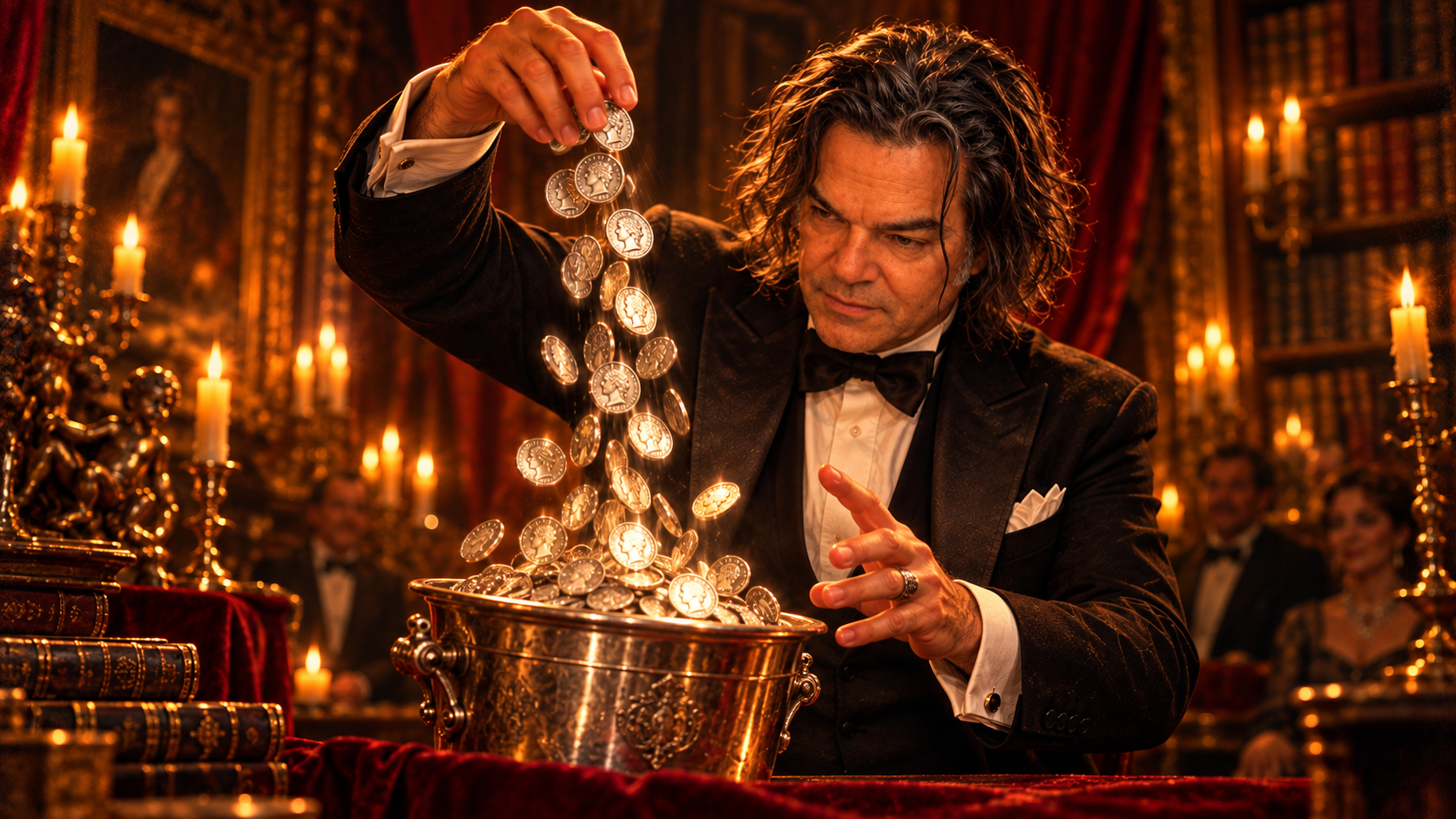
Eventually the magician needed somewhere to put all this newly discovered wealth.
A hat.
A bowl.
A metal pail.
A bucket.
Some kind of receptacle became part of the routine.
And that seemingly practical addition gave the effect something enormously important.
Sound.
A coin could now be seen appearing—
and then heard landing.
Clink.
Another coin.
Clink.
Another.
Clink.
Each sound confirms what the eyes have just witnessed.
The audience doesn’t simply see the growing collection.
They hear it accumulating.
The container becomes almost a second performer.
Every strike of coin against metal says:
There’s another one.
And another.
And another.

The Trick Begins to Grow Into Theatre
This is where I think the Miser’s Dream becomes particularly interesting.
At first glance, the effect is about producing coins.
But that isn’t what keeps an audience watching.
If the magician simply performed the identical motion twenty times, the secret might remain mysterious—but the routine could become repetitive.
The entertainment comes from how the idea develops.
Where will the next coin come from?
Will the magician find one on a spectator?
Will several suddenly appear?
Will the pace increase?
Will the container become impossibly full?
Will the magician himself appear surprised that the money keeps coming?
Now we are no longer merely dealing with sleight of hand.
We are dealing with structure.
And structure is what allows a trick to grow into a routine.
THEATRE MAGIC · THE PRINCIPLE
Repetition becomes entertainment when each repetition changes the experience.
— Attillio
That distinction is critical.
The audience may understand that another coin is going to appear.
But they shouldn’t know:
where, when or how.
That’s what keeps curiosity alive.
The effect remains the same.
The experience keeps changing.
From Production to Escalation
This gives us a beautiful progression:
One coin establishes the miracle.
A second confirms the miracle.
Several coins establish the magician’s impossible ability.
A growing collection creates abundance.
And eventually—
the coins seem almost impossible to stop.
That is escalation.
The routine has gone somewhere.
We began with almost nothing.
Now we have a container filling with money.
The magician isn’t simply repeating the same trick.
The impossible situation is becoming larger.
Why the Miser’s Dream Endured
The Miser’s Dream survived because it is based on an idea that almost anyone can understand.
You don’t have to know anything about magic.
You don’t need to understand a complicated set of rules.
There is nothing abstract about the effect.
The magician reaches into apparently empty space—
and produces money.
Again.
And again.
And again.
And every additional coin strengthens the fantasy.
It’s easy to see why generations of magicians would continue exploring that idea.
Because somewhere inside the Miser’s Dream was another realization:
Coin magic didn’t have to remain a small trick performed between two hands.
It could fill a stage.
It could develop rhythm.
It could involve spectators.
It could have a beginning, middle and climax.
It could become an act.
And near the turn of the twentieth century, one performer would push that idea dramatically forward.
His specialty was coins.
His reputation traveled internationally.
And his billing said almost everything you needed to know:
T. Nelson Downs — The King of Koins
Downs became extraordinarily successful with coin manipulation, and his popularity helped inspire other coin-manipulation acts on vaudeville stages. His work also became an important part of the published literature of coin magic.
THEATRE MAGIC DIAMOND
Don’t simply repeat the effect. Escalate the experience.
One magical event creates surprise.
Repeated thoughtfully, it creates anticipation.
Built progressively, it creates a routine.
And driven toward a climax—
it becomes theatre.
T. Nelson Downs: When Coin Magic Became an Act
The coins were astonishing. But the greater lesson was how one performer took a simple magical idea and built an entire theatrical identity around it.
By the beginning of the twentieth century, coin magic was no longer confined to the quiet movement of a coin between two hands.
It could command a stage.
And one performer became so closely associated with that transformation that his billing eventually became part of magic history:
T. Nelson Downs — The King of Koins
Thomas Nelson Downs was born in Iowa in 1867 and became internationally known for his skill with coins. His reputation was built not around dozens of unrelated illusions, but around an extraordinary specialization: making ordinary pieces of money behave as though the normal rules of the world no longer applied. Contemporary magic references still identify Downs with the title “King of Koins” and credit him as one of coin magic’s most important innovators.
That specialization contains an important lesson.
Downs did not need to become everything.
He became known for something.
And he became so good at it that the something became inseparable from the performer.
The Power of Becoming Known for One Thing
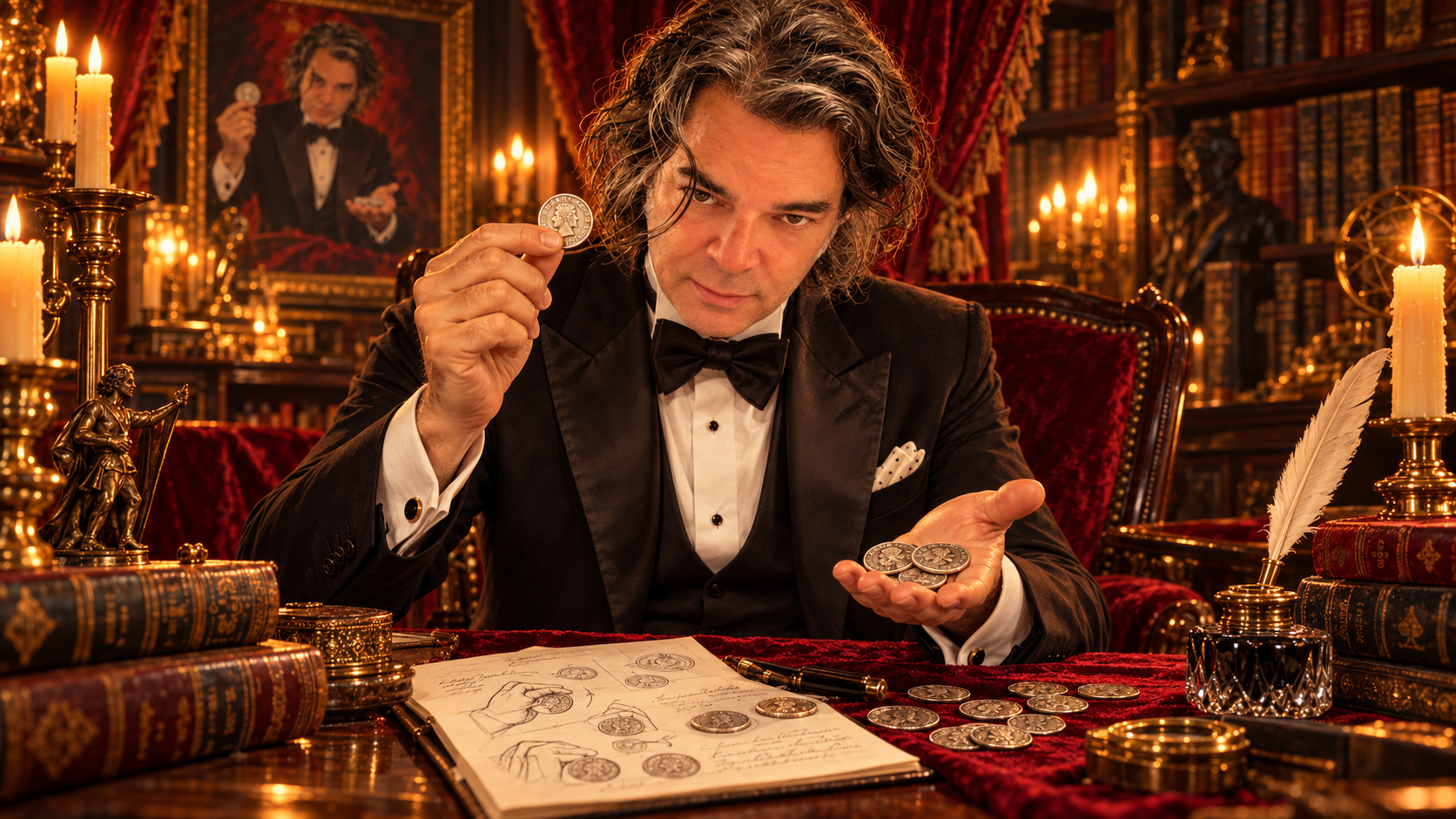
There is something worth studying in the name:
The King of Koins
Before the performance even began, the audience had been given an expectation.
Coins mattered.
Something remarkable was going to happen with them.
And the performer standing before them was apparently the man to do it.
That is positioning.
Today we might call it branding.
But performers understood the principle long before anyone used that word in its modern marketing sense.
A clear identity makes a performer easier to understand.
And easier to remember.
Downs could certainly perform more than coin magic. His later book The Art of Magic, created with John Northern Hilliard, includes material with cards, coins, balls and other forms of conjuring. But it was his extraordinary association with coins—particularly his version of the Miser’s Dream—that defined his public reputation.
There is a Theatre Magic lesson hiding inside that history:
The audience doesn’t need to remember everything you can do. They need something unforgettable to remember you by.
He Didn’t Simply Produce Coins
Think back to our previous section.
A magician produces a coin.
Then another.
Then another.
That alone can be technically impressive.
But Downs understood that the routine became stronger when the coins were connected to people.
Conjuring Arts describes Downs reaching into the personal space of spectators—finding coins around whiskers, sleeves, ties and handkerchiefs rather than simply producing every coin from empty air. He reportedly summarized the idea with the wonderfully visual phrase:
“Pull the coins from their whiskers.”
That small idea reveals something much bigger.
He changed the location of the miracle.
Instead of:
“Look what I can produce.”
The experience becomes:
“Look where I just found it.”
Now a gentleman’s whiskers might contain money.
A spectator’s sleeve might conceal a coin they didn’t know existed.
A handkerchief could suddenly become a source of wealth.
The audience was no longer merely observing the magician’s fingers.
Their world had become infected with magic.
And that brings us directly back to the principle we discovered with the coin behind the ear.
The magic becomes stronger when it seems to happen to the audience and around the audience, rather than existing exclusively in the magician’s hands.
From Dexterity to Entertainment
This distinction matters enormously.
A magician can spend years learning difficult sleight of hand.
And that skill deserves respect.
But the audience did not buy a ticket to admire how many hours you practiced.
They bought a ticket for an experience.
Downs possessed remarkable technical ability. Modern Coin Manipulation, published around 1900, documents an enormous collection of coin vanishes, productions, palms, passes and methods connected to his work, including extensive treatment of the Miser’s Dream. The book even describes feats involving large quantities of coins and methods for producing them in increasingly startling ways.
But technique alone doesn’t explain his reputation.
Conjuring Arts also describes him as a showman whose dexterity was combined with humor and interaction.
That is the part magicians should notice.
The technique supported the personality.
It did not replace it.

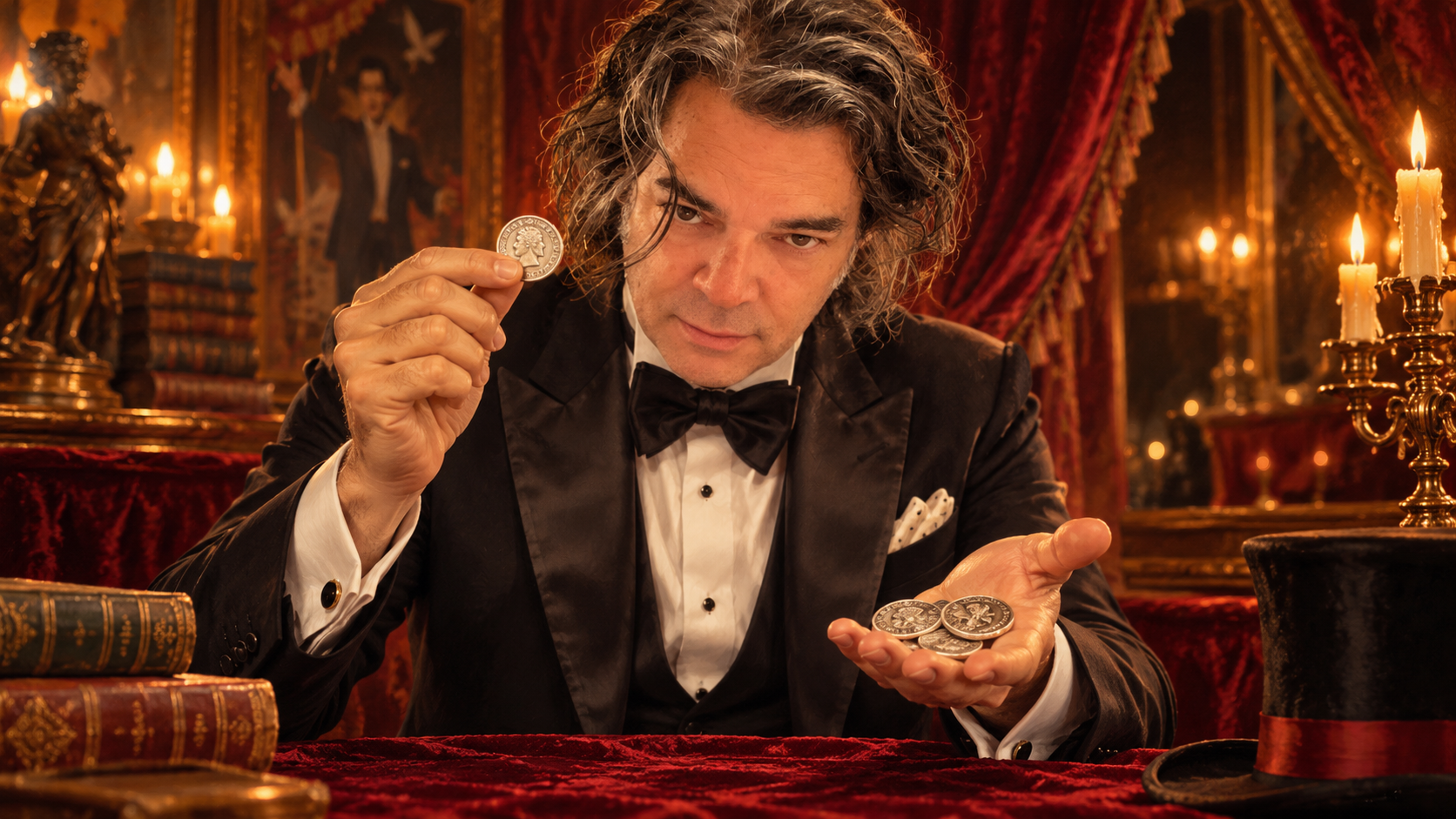
Every generation studies what came before, then discovers what it can add.
I particularly like this image here because now Attillio doesn’t visually represent Downs.
He represents the next magician studying the lineage.
That becomes important for where our story is heading.
Every Generation Adds Something
Magic rarely develops in a straight line.
One magician discovers a move.
Another changes the handling.
Another changes the presentation.
Someone else changes the setting.
Another performer combines the idea with a completely different premise.
Eventually the effect may look very different from where it began—
yet the original idea is still hiding underneath it.
That is exactly what happened with coin magic.
The simple production of a coin became the Miser’s Dream.
The Miser’s Dream became a vehicle for performers such as Downs.
Coin manipulation became increasingly sophisticated.
Methods were documented.
New generations studied them.
And gradually another intriguing idea emerged.
Instead of asking:
What if I could find money everywhere?
A magician could ask something slightly different:
What if everything I touched could become money?
Now we are approaching one of humanity’s oldest fantasies.
A story far older than the Miser’s Dream.
The story of a king who was given an extraordinary—and ultimately dangerous—gift.
Everything he touched turned to gold.
His name was Midas.
And the idea of the Midas Touch would provide coin magicians with another beautiful way to frame the impossible.
THEATRE MAGIC DIAMOND
Don’t try to be remembered for everything. Give the audience something unforgettable to remember you by.
Downs didn’t become the King of Everything.
He became—
The King of Koins.
Sometimes narrowing what you are known for doesn’t make the performer smaller.
It makes the identity stronger.